History of Dekaf Records
Early Days
Dekaf Records was founded in 1958 by English, music entrepreneur, Jimmy Lyle. Jimmy was brought up in the London suburb of Twickenham. As a youngster he always had a passion for music, but never really had the talent for playing instruments. He tried to learn plenty of times, but never quite got the hang of it. It was after he left school that he realised he could still be in the music industry by being a music promoter instead of a musician. He was a canny operator and managed to convince a few local bands in his area to trust him to book gigs. He was only 19 when he first got his first clients. Jimmy had the gift of the gab and was able to get good bookings for his artists in pubs, clubs, and theatres. He soon became a real character in the local music scene. There was no gig he couldn’t book and no price he couldn’t negotiate. Jimmy lived this life for a good three years before realising that he didn’t get much of a cut on all the bands he was promoting. He wanted a bigger part of the pie. That bigger piece came in the form of actually becoming a record company that would create and produce it’s own recorded music. In the year 1961, Jimmy was able to rent out a small office building in Twickenham to house his newest musical venture, Dekaf Records.
The name Dekaf came from a funny incident Jimmy had on holiday to New York. He had some time off his promotion gigs and wanted to see what all the fuss was about in America. He was in a Brooklyn coffee shop and overheard one of the baristas calling for a “decaf” cup of coffee. Being pretty new to this coffee lark, Jimmy didn’t know what the word meant, only the fact that he liked the sound of it. When he got back to England he registered the name Dekaf Records. The only issue was that he was dyslexic and obviously didn’t know the correct spelling for the word he had heard at the coffee shop. The name had been registered so that was what he ran with. He grew to love the name and we love it too all these years later.
With his new name and new office space, Jimmy was finally able to sign some new acts. He had a few early bands join up with him. His early roster mainly consisted of artists he had already promoted. His first big success came with The Refunds. He had been sent their music by a local promoter in Chester and he took a punt on the band. It paid off as the band were the first group to be a hit for Dekaf Records. With the incoming money from the new band, Jimmy was able to hire a few talent scouts to scour the country for new talent. He even opened up a branch of Dekaf Records in New York. He didn’t want to miss any talent in the UK or across the pond so he made sure he couldn’t let any great artist slip through his fingers. It was because of this policy that Dekaf were able to scout out and sign Penchant for Lettuce as their first band from the USA.
The Big Time
Things were really on the up for Jimmy. He now had a few successful bands on his books that he could promote and help with their careers. One of the biggest benefits to his business in it’s early days was the way that he and his office operated. Jimmy was happy to have the two transatlantic offices, but wasn’t as keen on having other property to up keep. In this vein, he never had his own recording studio, but would rather rent out ones local to the performers. He always felt his acts would create better music if they were near where they were from, rather than living in hotels far from their home towns. With the money he saved he was able to pay his artists better cuts compared to other music labels. This helped them survive as artists without worrying about other jobs, and stopped them from swapping to different record companies.
With these great business practices, Jimmy and Dekaf were able to entice new acts and already established artists to join him at his record company. This went on through the 1970s with Milkshake Moustache joining the fold during this decade. Jimmy never wanted Dekaf to become a stale company so he always freshened up his roster of acts. He was a lover of all kinds of music so never really said no to any style or genre. Dekaf were happy to have popular acts as well as more obscure ones. For a man of his age at the time, Jimmy was incredibly open minded about almost any type of music, as long as he felt he could promote their work and make some money on it he would give anyone a go.
It was in 1975 that Jimmy married Deborah. Deb, as Jimmy called her, had first met each other when she turned up at the offices hoping for a contract. She played her guitar in front of Jimmy and a few trusted friends in his office. Unfortunately for Deb, she wasn’t particularly good. They had to tell her she wasn’t good enough at the moment for what they were looking for. Jimmy was incredibly sympathetic towards her, probably helped by his attraction towards her, and invited her to the local pub to console her. They hit it off and were married within a year much to their family’s shock. It took another 3 years before their first and only son, Timothy Lyle was born.
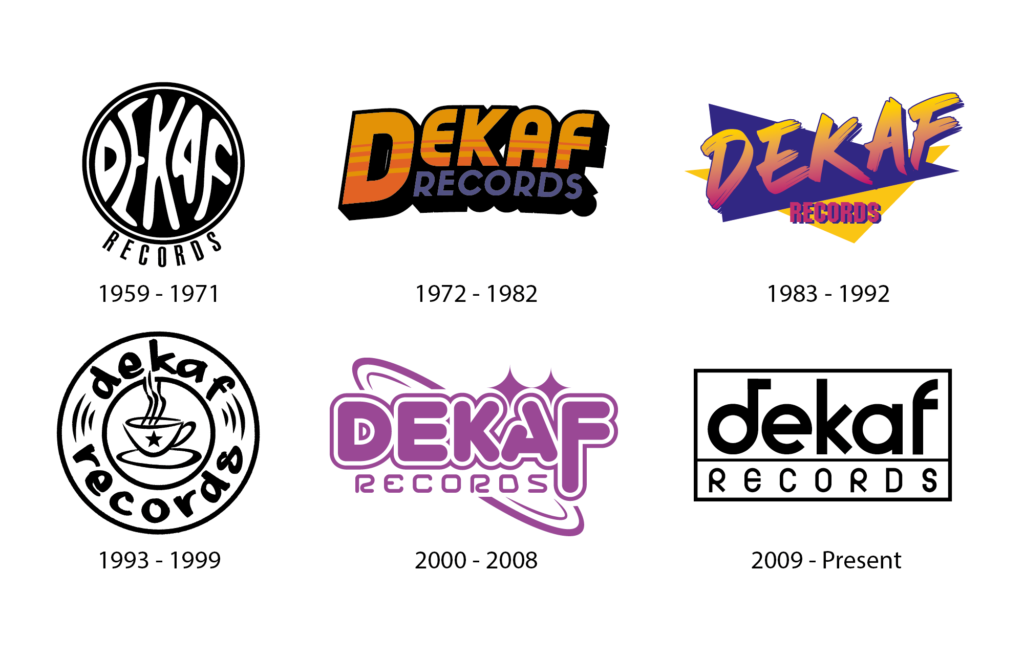
This style of moving with the times also worked with the company’s branding. Jimmy never wanted to be standing still so every few years he would get an up and coming graphic artist to redesign our logo. He would often hire out this job to local art school students and if he liked their ideas he would offer them a job within their in house art department. Dekaf has had six different logos to date with each one of them representing the business and music at the time they were used.
Steady Sailing
The 80s were a steady decade for the business. Dekaf were hiring more and more acts with one of the biggest coming from Cornwall, named Robyn Coodle. Jimmy had a real hand’s off attitude toward his artists. He knew that they knew best when it came to their music so he rarely ever stepped in the way with his own ideas. The only advice he would give would be with the album art and the promotional materials. This was his great strength and many artists over they ears could attest to sharp knowledge of marketing.
Jimmy knew when to do the work and when to delegate and that was the whole success of Dekaf Records. He wasn’t afraid to listen to others and their opinions. His office was always open to anyone and everyone who wanted a chat, bringing a fun and unbusinesslike atmosphere to the HQ. Jimmy loved nothing more than having a good chinwag with any local artist who fancied popping in. He would also enjoy bunking off from his admin work to go to a local pub to listen to an up and coming act.
The 1990s followed a familiar path. New bands and acts from both sides of the Atlantic were all on the books of Dekaf Records. CDs were now over taking vinyl and cassettes as the best way to listen to music. Jimmy still says vinyl sounds better, but concedes that CDs are much easier to use. They were also cheaper to produce. This allowed Dekaf to take some more educated risks on groups without losing too much money. A few CDs of an album would be sent out to local shops to test the water for the artist. One band that really benefitted from this new risk-taking venture was the Third-Rate Reprobates. Their style hadn’t really took off at the time they were signed, but some clever strategies let Dekaf know they were onto a winner.
By the end of the 90s, Jimmy was seeing that he was getting out of touch with trends and new music. He always wanted Dekaf to be at the forefront of the industry and he no longer left he was on the cutting edge. It was with this in mind that he appointed his son, Tim, to take over the business. Tim was only 21 when he got the gig, but as he had grown up within the company he was able to hit the ground running. His first idea was to create a website for Dekaf. This was still fairly unheard of for music labels at the time, and he found he started getting many more enquiries through it. Jimmy took semi-retirement, but was unable to drag himself away from the business, so even after his son took over, you could often find him still in his often most days.
A New Millennium
The turn of the Millennium was a happy one personally for the Lyle family. Jimmy couldn’t quite believe the business he started was still going beyond the year 2000! Professionally it was a bit harder for Dekaf. Although Tim had the foresight of the internet, he didn’t quite foresee the music piracy it brought with it. Dekaf saw a steady reduction of their physical media being bought as fans took to dodgy websites to download the latest albums. This made 2002 the worst year on record for Dekaf. It was a worrying trend for the label and one that Tim took personally. To counteract all the piracy, he embraced it. He took the clever move to publish all songs from current artists onto the internet. He made sure that each song was in a poor quality format, and he always took a verse out of each recording. Amazingly this ploy worked. fans would listen to the illegal versions of the songs and get so into the group or artist that hey would go out and buy the album for further, better quality, listening. The next year’s profits were back up and Dekaf lived to fight another day.
Dekaf did well over the decade as old fans of old Dekaf artists became nostalgic for the songs of their childhood. Now the internet was becoming more mainstream, these fans were able to purchase the music directly from the Dekaf website. These nostalgic fans also helped Dekaf with another sideline, themed concerts. We could now hold entire events featuring old Dekaf bands from the era. People snapped up the tickets immediately as many thought it would be the last time to see some of their favourite bands.
Dekaf were very early adopters of the streaming music trend back in the early 00’s, so when big platforms started appearing in the 2010’s we were ready to strike. The revenue share of the platforms works well for us, allowing us to know the exact figures of the artists on our label. It also helps our acts to reach a wider fanbase. In the old days before the internet, bands would need lots of promotion to make it big, but now a small act can became famous with just one good viral song. It’s really changed our method in promotion and given us plenty of chances to be creative.
Jimmy and Deborah are still around and still taking interest in the music business. They have retired to Exeter to avoid the hustle and bustle of London. Jimmy is now an avid fan of Exeter City football club and follows them home an away even at his ripe old age of 83 at the time of writing. Deb is a keen gardener and loves the countryside of mid Devon. Tim is still at the helm and leading dekaf through it’s next chapters. The future for Dekaf is bright, and we hope this new website celebrating our old artists with new merchandise and information will be enjoyed by many.